
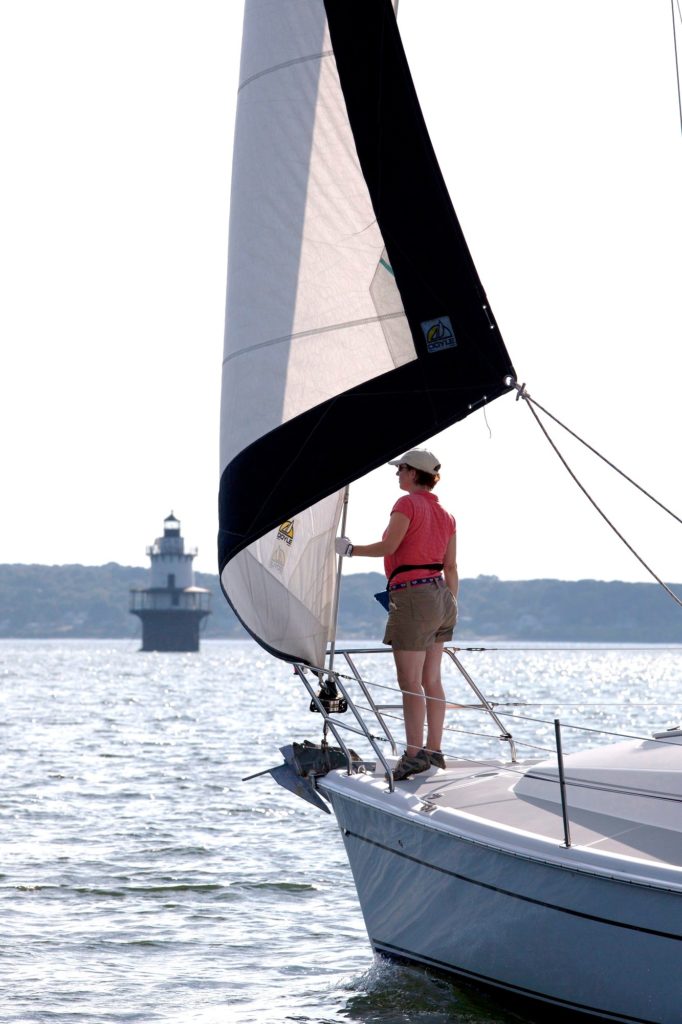
American Sailing Association handbook, Bristol, RI
How do we guide you to the right boat? EDUCATION!
We will first ask many questions about what you think you want and WHY. Like a good coach we will ask you questions that will make you think and delineate logic from emotion. Buying a boat can be a very emotional process, and (initially) logic should choose the path.
We will go into detail about differences between boats. Every boat is a serious compromise. You will learn how displacement determines how a boat “feels” and how speed and sailing comfort can oppose each other. Why are some manufactured boats expensive and some not? What is the difference? Am I safer in a better pedigreed boat, what am I spending the extra money on?
Then there is how a boat ages. What can you expect to go wrong at what age? When do sails wear out? When is a deck suspect? Which model engines are better and why? When should I be worrying about the rigging? We will have quite the talk about how a boat ages, and what goes bad at what point.
Then there is the talk about how a boat depreciates. The facts here will really surprise you! It is nothing like a car! Although the value of a new boat drops about 20% immediately, it is surprisingly stable after that. It is condition and equipment that is critical. I can show you statistics that back up our claims.
The seasonality talk is usually surprising to buyers. Some think fall is the best time to buy, some think spring. We think there are good deals all the time; one needs to look at how long a boat has been on the market (which we can tell) and what is the value vs the asking price, and how motivated is the seller. That said, the most used inventory is found in the fall. The most motivated sellers are after their boat has been on the market over a year!
What about the sales process? What do boats generally sell for compared to asking price? What initial offer is insulting and what will get me the price I want without pissing off the seller? An offer is TWO things; how much and what conditions? What conditions are normal and which ones will turn off a seller? What time frame is normal? We can help you with all of this and make it straightforward.
Then there is the survey (inspection.) We can guide you to a good one, and trust me there are some that are not so good. How much does it cost and what expenses are there besides the surveyor himself? It is the surveyor’s job to tell you what is wrong with the boat, and even on a solid boat the report can make it seem it is on its last leg. We can help you interpret this document, and advise what is normal wear and tear and what is a red flag.
So let us be your coach on this journey to find the right boat. Costs you nothing to have us be a Buyers Broker but will pay big dividends!